Chemistry Research, Ed-Tech, Chem10 and QOOL: An Instructor Spotlight with Dr. DeMello
Dr. Nick DeMello teaches the Analytical and Organic Chemistry (OC010A) class at OHS. We had the opportunity to interview him about his journey from chemistry research to building edtech software and finally joining OHS and building the Chem10 class and QOOL Lab here.
Dr. DeMello currently teaches in Redwood City, California - the same city where he was born and raised. His family had a farm in the region; his mother was a farm girl and his father was the son of an immigrant. His grandfather arrived in New York from Portugal with nothing more than an empty suitcase and a hat - he worked in several areas to make a living, from a fisherman, mechanic to eventually becoming a machinist. Dr. DeMello’s father grew up on the streets of San Francisco, was a boxer and worked in the military. He later became a business, math and computer science teacher in the Redwood City school district, teaching for 44 years. Dr. DeMello said that “as far as I know, there was only one person in the district who taught for longer.”
Dr. DeMello attended Sequoia High School before going to UC Berkeley. He entered Berkeley as a math major but eventually shifted to chemistry, where he became involved in research. He worked with Henry Rapoport, an organic chemist, and was influenced by Professor Dennis P. Curran, whose presentations on organic synthesis using free radicals that he attended inspired him greatly.
After graduating, he knocked on Curran’s door and told him he wanted to pursue a PhD under his guidance. Though Curran encouraged him to explore other schools and professors, Dr. DeMello was certain. He moved to Pittsburgh, Pennsylvania where he completed his PhD, working in free radical chemistry and computational chemistry.
Around this time, as the internet was beginning to rise, Dr. DeMello became involved in early online communities. He was a member of the Usenet group comp.sys.mac.programmer, one of the first virtual communities. He advocated for splitting the group into seven sub-groups, and served as the monitor for the “info” group.
After earning his PhD, he moved to Los Angeles to work with Professor Ken Houk at UCLA. Houk was deeply involved in computational chemistry and worked at the cutting edge of system development in the field. Dr. DeMello worked there for one to two years, doing research he describes as genuinely interesting.
While at UCLA, he became involved with the Center for Digital Innovation (CDI), a program he describes as “a group that got together to build something that would later be called ed-tech.” The group explored digital formats including digital versatile disks, also known as DVDs. The team consisted of seven physicists and one chemist (Dr. DeMello), all of whom were also programmers.
They began working on a project called cyberChem, which aimed to deliver general chemistry across two CD-ROMs. As Dr. DeMello explains, “The idea was to be able to sell what was called encapsulated learning, or basically an educational learning that was encapsulated. We do it on iPads now, but back then it was done on CD-ROMs.”
McGraw-Hill was interested in this project, and Dr. DeMello offered to build a Mac version of the system. Initially, they declined the offer but a few years later, they changed their mind and eventually provided them with a million dollars a few weeks after reopening discussions after meeting at a research presentation. Dr. DeMello spent three-quarters of the year building the Mac version. During this period, he also worked on building infrastructure for the Malaysian Ministry of Education as part of a multimedia super corridor project.
He also worked with Disney on a DVD-related project that featured two versions of the same movie, one from the perspective of the father and one from the child’s. One of the most exciting features of DVDs at the time was the ability to switch tracks, which allowed viewers to switch between different perspectives mid-scene. You could be watching the movie from the child’s point of view, wonder why the parent acted in a certain way, click a button to switch tracks and see the action from the parent’s perspective.
A contact Dr. DeMello had met at Usenet ran MacTech, a journal on Macintosh programming. After noticing that Dr. DeMello’s posts were now coming from UCLA instead of Pittsburgh, he invited him to write for the magazine. He started writing articles and eventually wrote a column called “MacTech Online,’ which surveyed online resources.
At the same time, the publisher was developing an idea for an online store for programming tools and invited Dr. DeMello to work on it. He transitioned into that role full-time, and built a full online store while eventually becoming an editor of the MacTech journal.
Later, he moved to Long Beach, where he worked for marketing MathType, a program that, as he describes, “allows you to put mathematical equations into Microsoft Word.”
Eventually, family needs brought Dr. DeMello back to Redwood City. He began teaching chemistry at a local community college, and after a couple of years, learnt about Stanford’s Online High School program. The program sounded interesting to him, and he decided to join.
When Dr. DeMello signed up with OHS in 2015, he was initially uncertain. He said, “I had never taught high school before. I was a little nervous about it. But they said these aren’t your average high school students.” He was hired to teach AP Chemistry, but said that “I didn’t even know what AP Chem is. They literally hired me the day before the class started so I just took my normal slides and walked in the door and started teaching collegiate-level general chemistry.” He built the class Canvas shell while continuing to teach the course. As Dr. DeMello explains, “at the end of the first year, we had a model - we were going to call it AP chemistry, but it’s not really AP chemistry. We’re giving them collegiate-level chemistry. The students loved it, so I signed up for another year.”
In recent years, Dr. DeMello began expanding the class to include organic chemistry. Because traditional take-home labs were not possible for organic chemistry, he began experimenting with molecular modeling. As he explains, “We developed QOOL. I had tried to set up a similar software earlier, but the problem was that the software required was very expensive so I knew that was the bottleneck.”
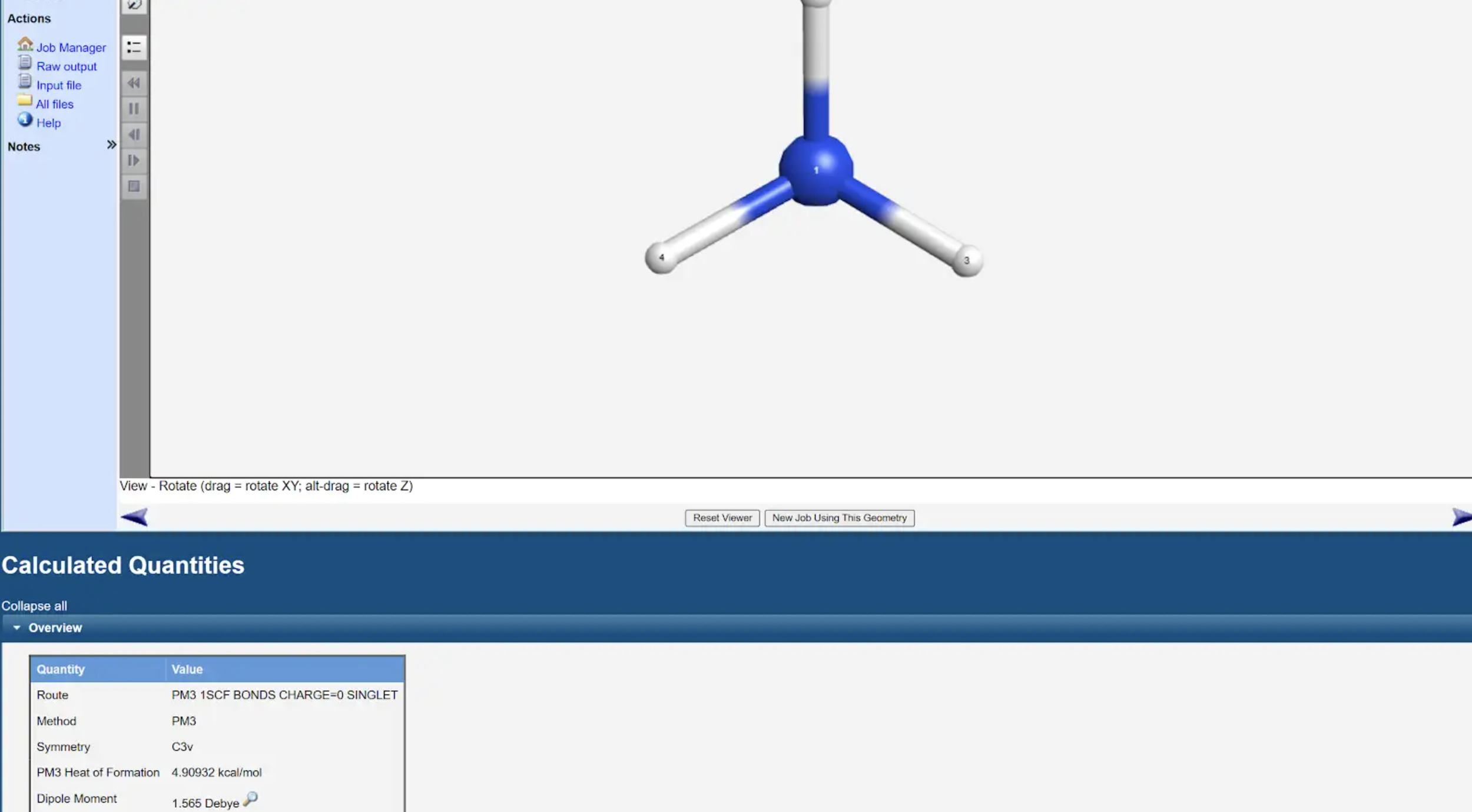
Eventually, he found a solution - “I found a software called WebMO, which is just a shell that you can open in a web browser that you can plug other software into. This allows students to do the discovery and really explore organic chemistry. We are not done with this, we are still exploring - what we’ve got so far is a course that is so far about 75% general chemistry and 25% organic. My hope is that over the years, we will turn this into one semester of pure analytical chemistry and one semester of organic. Maybe at some point we will get a full year-long organic class.”
When asked about his favourite unit in Chem10, he said, “Molecular Orbitals because I've had to teach it in a lecture hall before. Teaching molecular orbitals in lecture halls is kind of like teaching swimming on a ski slope, it is difficult to make it work. In a virtual world, it is almost like teaching swimming in the ocean. Being able to pull up these orbitals and to have that computational engine to not just show them the pencil work and how you can do a simple diatomic, but actually get their hands on Schrodinger's equation and crunch out real orbitals gets me excited.”
Talking about memorable moments in class, some of his most memorable ones have come from learning alongside his students. He said, “I like giving students hooks for ways to remember different things. When we were talking about the ideal gas constant, another version of it has to be used when we get into entropy. One day, I had a student look at it and go “Oh, that’s 8.pi!” The best moments I've had in this school is when I've learnt something from the students. That was a very memorable moment for me.”
Outside of teaching, Dr. DeMello has a wide range of interests. As he describes, “I love skiing and surfing, I'm a very good skier, a very bad surfer, but I love both of them. My dad used to take us backpacking every summer so I loved that.” He is also an avid gamer. “I do love video games, I play World of Warcraft; I am a druid and I've been a druid since vanilla and I spend a lot of time in that virtual world. I think there are a lot of parallels between online gaming and online education - a lot of things we are running into in online gaming with artificial intelligence, we have the same situations in education. In terms of encouragement, in terms of plateaus - how do you get the players engaged, how do you get students engaged? How do you get them to care enough to reach but not be afraid to reach when you reach these plateaus? That type of wiring into the game system is the same thing you do in teaching. This takes us into the idea of gamification, taking some of the lessons learnt in gameplay into education, which I am a big fan of.”